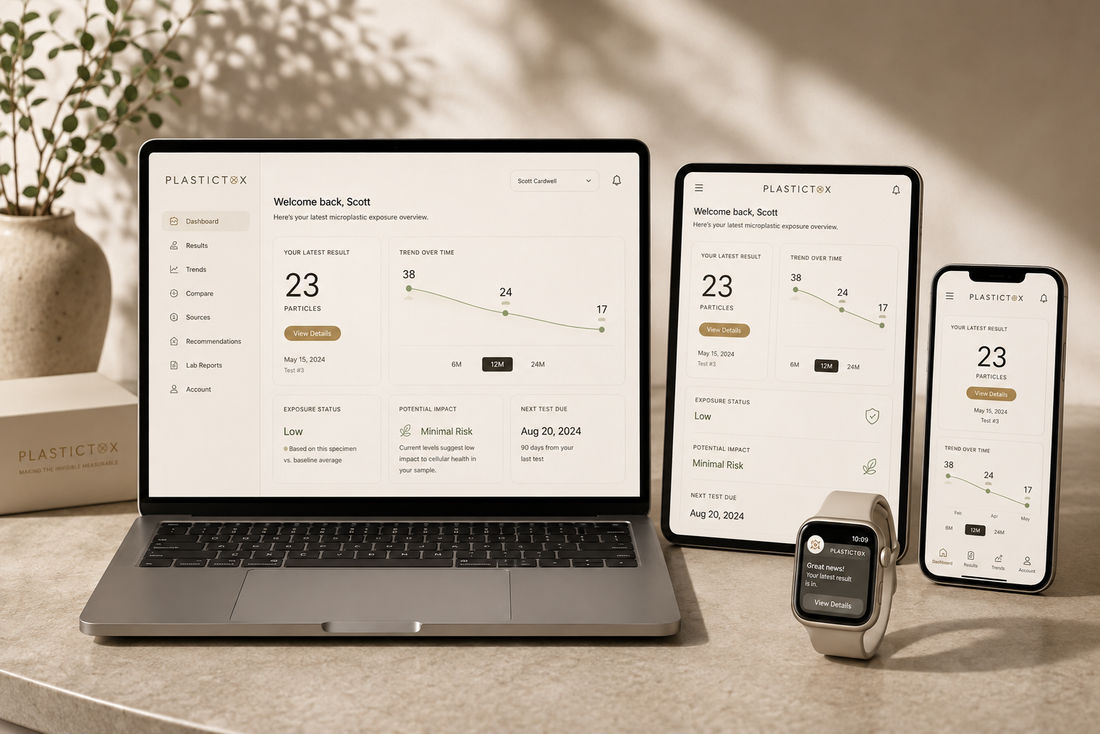
A point in time
One saliva sample is a snapshot of that collection—not a complete measure of microplastics throughout your body or lifetime exposure.
The science · Stated plainly
PlasticTox uses Nile Red staining and observational microscopy to screen a saliva sample for candidate particles visually consistent with microplastics. The result is an awareness snapshot—not polymer confirmation, a diagnosis, or a clinically validated measure of exposure.
For adults · Awareness and education only
The workflow
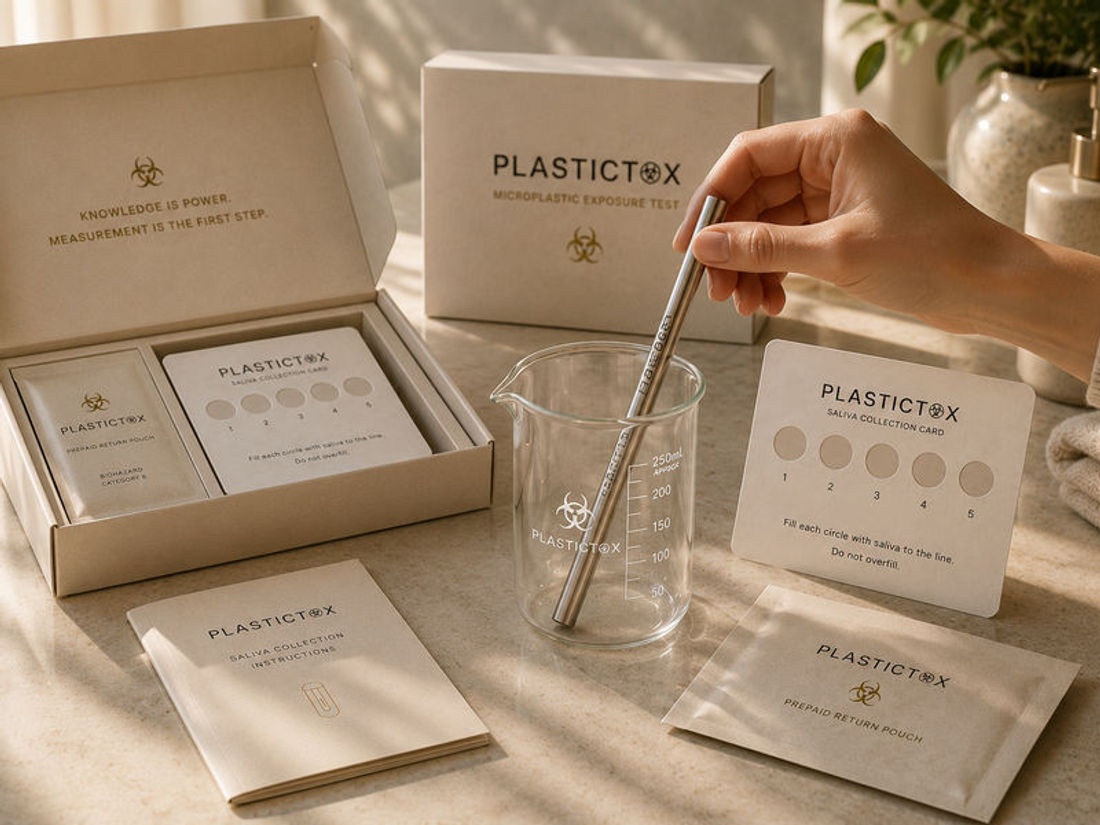
The process is intentionally simple at home. Interpretation happens after your dried collection reaches our lab.
 Our lab observational review
Add a saliva sample to the five-circle collection card, following the kit instructions.
Let the card dry as directed, seal it in the supplied materials, and use the prepaid return.
Our lab prepares the received sample and applies Nile Red, a fluorescent dye used in published microplastic-screening methods.
Microscopy is used to observe and count fluorescent candidate particles. Your private digital snapshot follows after review.
The essential distinction
Particles whose appearance and fluorescence are visually consistent with microplastics under the screening method.
Polymer identity. PlasticTox does not use µFTIR, Raman spectroscopy, or pyrolysis-GC/MS to confirm each candidate particle.
Published platform research · 2026
A Mayo Clinic-led prospective observational case-control pilot used the PlasticTox collection platform with peripheral blood from 29 adults. It was a study of blood—not this consumer saliva screening.
particles per 100 µL of blood in the combined COPD/IPF groups versus controls (p < 0.01).
What it found
The pulmonary-disease groups had higher reported particle concentrations than controls, especially in the smaller size fractions. The paper describes the finding as exploratory and hypothesis-generating.
What it did not prove
The small, single-center study cannot show whether particles contributed to disease or accumulated because disease was already present. It did not clinically or analytically validate the PlasticTox saliva test.
Read the pilot with these limits in view
What one result means
Good screening language makes the uncertainty visible. These are the lines PlasticTox does not cross.
One saliva sample is a snapshot of that collection—not a complete measure of microplastics throughout your body or lifetime exposure.
A higher or lower candidate-particle count does not establish disease, risk, prognosis, toxicity, or a medically safe level.
The screening does not measure phthalates, BPA, PFAS, or every chemical associated with plastic.
Two results may be compared as observational snapshots, but a difference is not a clinically validated measure of reduced exposure.
PlasticTox is for adult awareness and education. It is not FDA-cleared or approved as a diagnostic test and is not intended to diagnose, treat, cure, prevent, or predict disease. Do not make medical, dietary, or treatment decisions from the result.
Primary sources
Nile Red, fluorescence microscopy, and image analysis for environmental microplastic screening in a reported 20–1000 µm range.
PubMed ↗ 02 · Method limitsNel et al., 2021Polymer type, shape, size, color, staining procedure, and sample matrix can affect Nile Red fluorescence and detection.
PubMed ↗ 03 · Human pilotHelgeson et al., 2026The Mayo Clinic-led 29-person blood pilot using the PlasticTox platform, with its complete methods and limitations.
Full paper ↗These independent or investigator-led publications help explain the method and its limits. They do not establish clinical validity for the PlasticTox saliva screening or constitute endorsement of the consumer product.
Read first. Then decide.
Two-minute saliva collection, prepaid lab return, observational screening in our lab, and a private digital result.